
Jewish Wroclaw is a project aimed at commemorating and emphasizing the achievements of the Jewish inhabitants of the city and their influence on its development. In our daily rush, we may not notice how many places or institutions were raised on their initiative. History, however, was not favourable to them. Much of it has been deliberately erased, and what has not been erased has been blurred or forgotten.
By indicating both existent and non-existent artefacts, institutions and buildings, I am trying to tell about the people who stood behind these undertakings. My goal is to outline the history of Wroclaw Jews and, on this basis, try to define the Jewish identity of the city. I am not deliberately presenting the entire legacy of Wroclaw Jews, but I only focus on the most important – in my opinion – manifestations of their activity in the city.
By creating this website, I would like to outline a relationship with the past and the past world, or – using an expression by Stefan Zweig, an Austrian writer of Jewish origin – with the world of yesterday. How to think about the history of Wroclaw Jews? Since today most of the city’s inhabitants are Polish Catholics, what and to what extent can connect them with German Jews? Is it just topography, architecture or the legacy of material and non-material culture? I ask myself what the cultural continuity between the Jewish Breslauers and the contemporary inhabitants of Wroclaw may look like and how to cultivate this continuity.
Of course we cannot make an attempt to understand the history of Wroclaw Jews in isolation from the history of the city. The fact that German Jews lived here before the war, unfortunately, condemns them to double exclusion from collective memory. After all, they are not the main subject of interest, neither for institutions fostering the memory of Poles nor the communities fostering the memory of Polish Jews. So I would like to point out a new possible direction – we do not have to be related by blood with the German Jews; it is enough that we are associated by the place. We do not have to think of them as ancestors; it is enough that they will be our predecessors. A change of perspective can open up to the past. Since the changed ethnic composition of the city discourages people from looking for information about the past, I would also like to point out that interest in local history is important for our current functioning in the city.
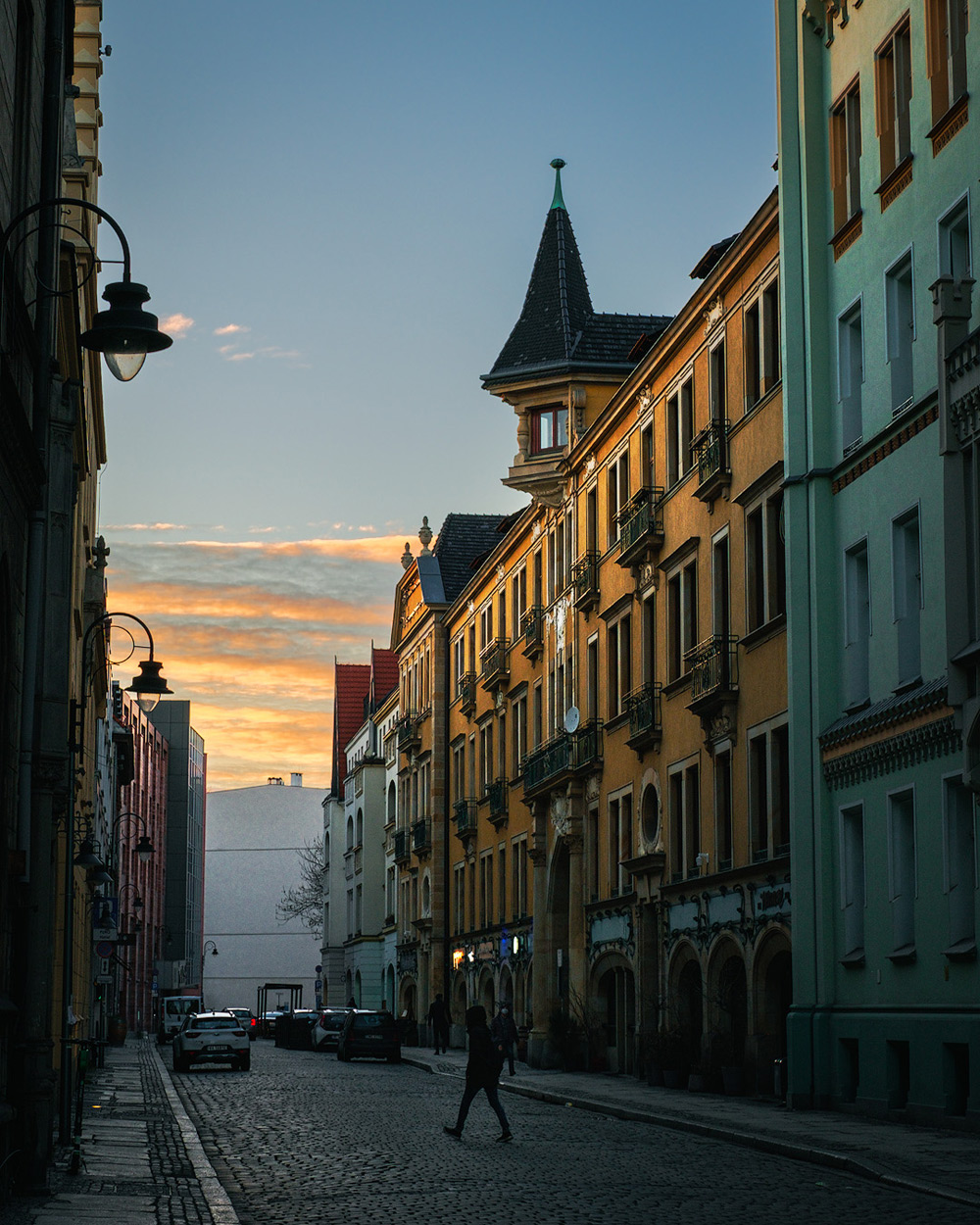
Włodkowica Street (Daniele Liberati)
This website also shows the history of Polish Jews and the revival of modern Jewish life in post-war Wroclaw. Bearing in mind the effects of the two totalitarian regimes, we know that it was not an easy process. Therefore I want to find out to what extent the non-Jewish inhabitants of Wroclaw derive from the currently developing Jewish culture and does this culture also draw from the experiences of German Jews? And after many inglorious experiences from the past, including in the recent history, are we able to create a real environment for mutual respect?
Undoubtedly, Jewish culture is currently enjoying great popularity, and there are many organizations and initiatives promoting it in Wroclaw. Opposite, however, there are neo-Nazi organizations, which are also recovering. When describing the story of Wroclaw’s Jews, I also look to the future: I am curious to see what the development of the city and the cultivation of common memory will look like not only by our generation but also by the generation of our children.